
The building boom
HSE records that immediately after the Second World War large quantities of asbestos were used, particularly in new system-built buildings through the 1950s, 60s and early 70s. ACMs were also routinely used during refurbishment of older buildings.
Schools, hospitals, factories, offices, housing, public buildings and industrial premises all formed part of that enormous construction and refurbishment programme.
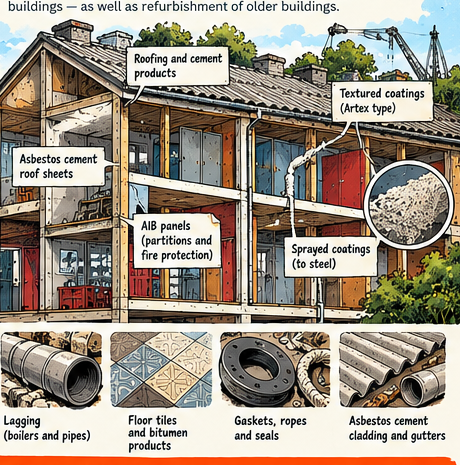
One mineral family, hundreds of uses.
Fire protection and insulation are the obvious applications, but asbestos was also useful as reinforcement and as a durable component of manufactured products.
- Sprayed fire protection and insulation.
- Pipe and boiler insulation and lagging.
- Asbestos insulating board for partitions, ceilings, linings and fire protection.
- Asbestos cement roofing, cladding, pipes, gutters, tanks and moulded fittings.
- Floor tiles, bitumen products and roofing felts.
- Textiles, ropes, seals, gaskets and electrical components.
- Textured and decorative finishes.
- Numerous moulded and composite products.
Mass use and health evidence overlapped.
By the post-war building boom, asbestos-related occupational disease was not an unknown concept. The regulatory and medical history developed over decades while use continued across different industries and products. The timeline therefore avoids the misleading idea that Britain first discovered asbestos was hazardous immediately before the final ban.