
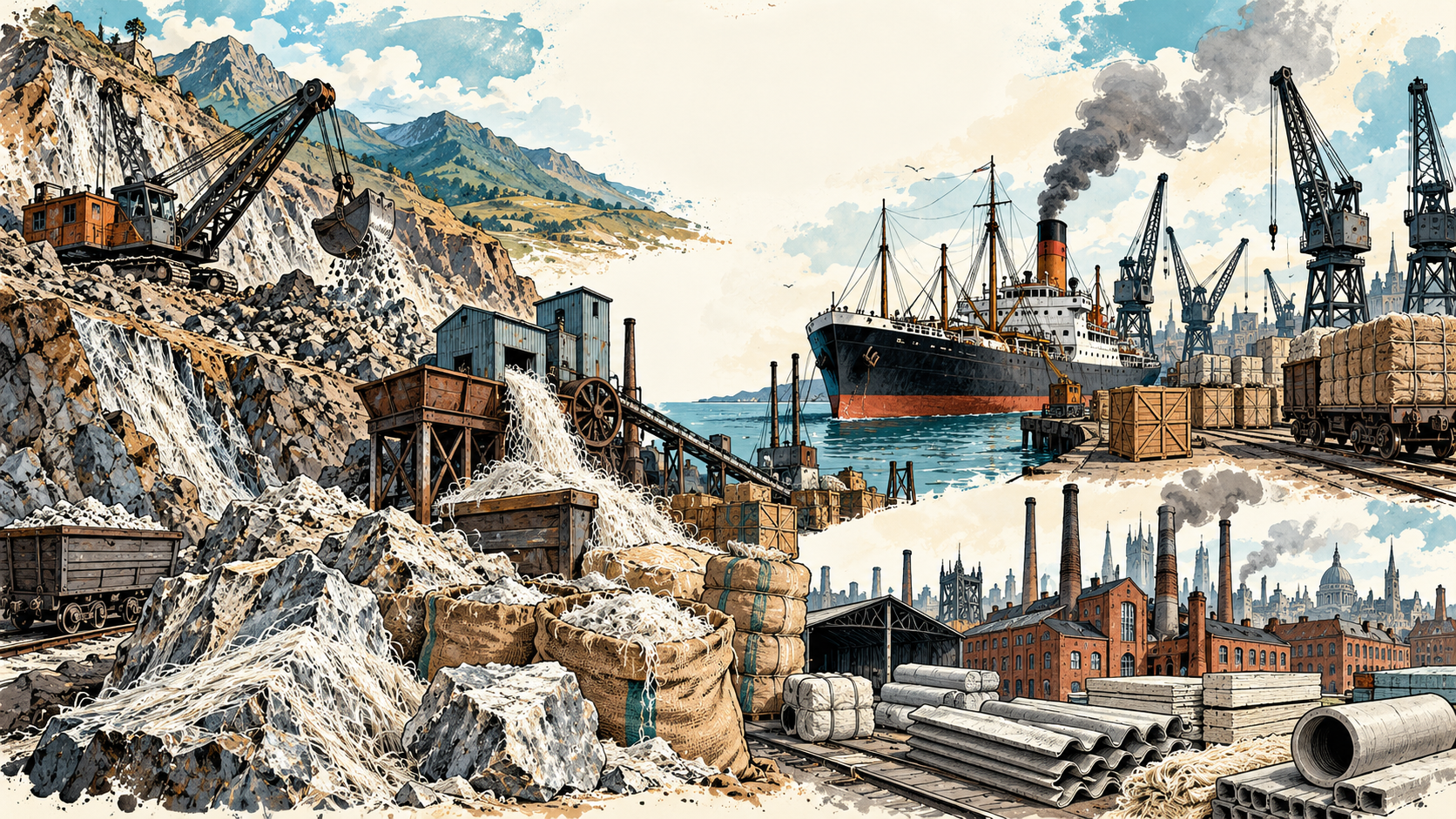
Asbestos wasn't invented.
Asbestos is the collective name for several naturally occurring fibrous silicate minerals. The three types most familiar in British buildings are chrysotile (white), amosite (brown) and crocidolite (blue).
The fibres occur naturally in rock. Once mined and processed they could be incorporated into manufactured materials, woven into textiles and ropes, or used for insulation and fire protection.
Britain imported it.
The UK did not build its asbestos industry around a large domestic asbestos-mining sector. Raw fibre and manufactured asbestos products came through international supply chains. Historically important producing regions included Canada for chrysotile, southern Africa for amosite and crocidolite, and the former Soviet Union/Russia for chrysotile.
For the website, the important point isn't a league table of mines: asbestos was a global commodity feeding British shipbuilding, engineering, power generation and construction.
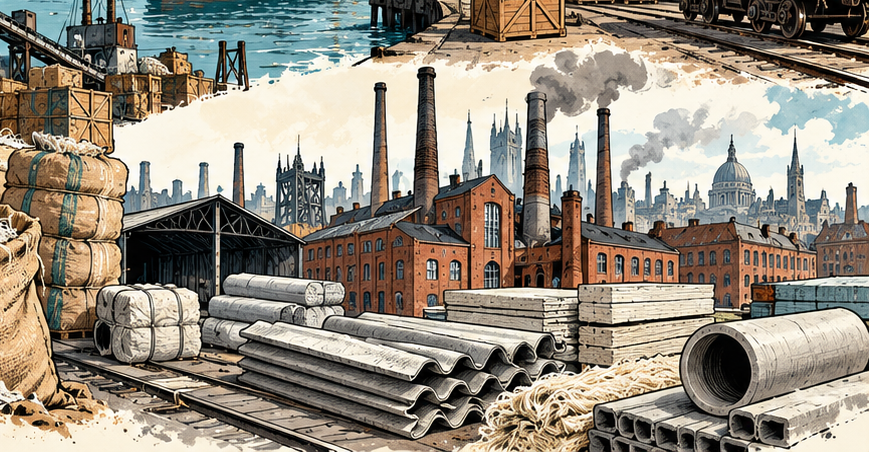
The properties explain the popularity.
- Resistance to heat and fire.
- Useful thermal and acoustic insulation.
- Durability and tensile strength.
- Resistance to many chemicals and corrosion.
- Fibres that could be woven or incorporated into cement, boards, coatings, plastics, bitumen and other matrices.
Those properties explain why asbestos turns up in such an extraordinary range of locations. They do not make every asbestos-containing product behave in the same way: the matrix, fibre content, condition and intended use all matter.
Commercial growth — and early evidence of harm
HSE records commercial use in the UK beginning around the end of the nineteenth century and increasing gradually up to the Second World War. As use expanded, medical evidence of serious occupational disease also developed.
Britain's Asbestos Industry Regulations 1931 introduced controls for specified asbestos manufacturing processes. That is an important historical marker: regulation of asbestos exposure did not begin in the 1970s or 1980s.